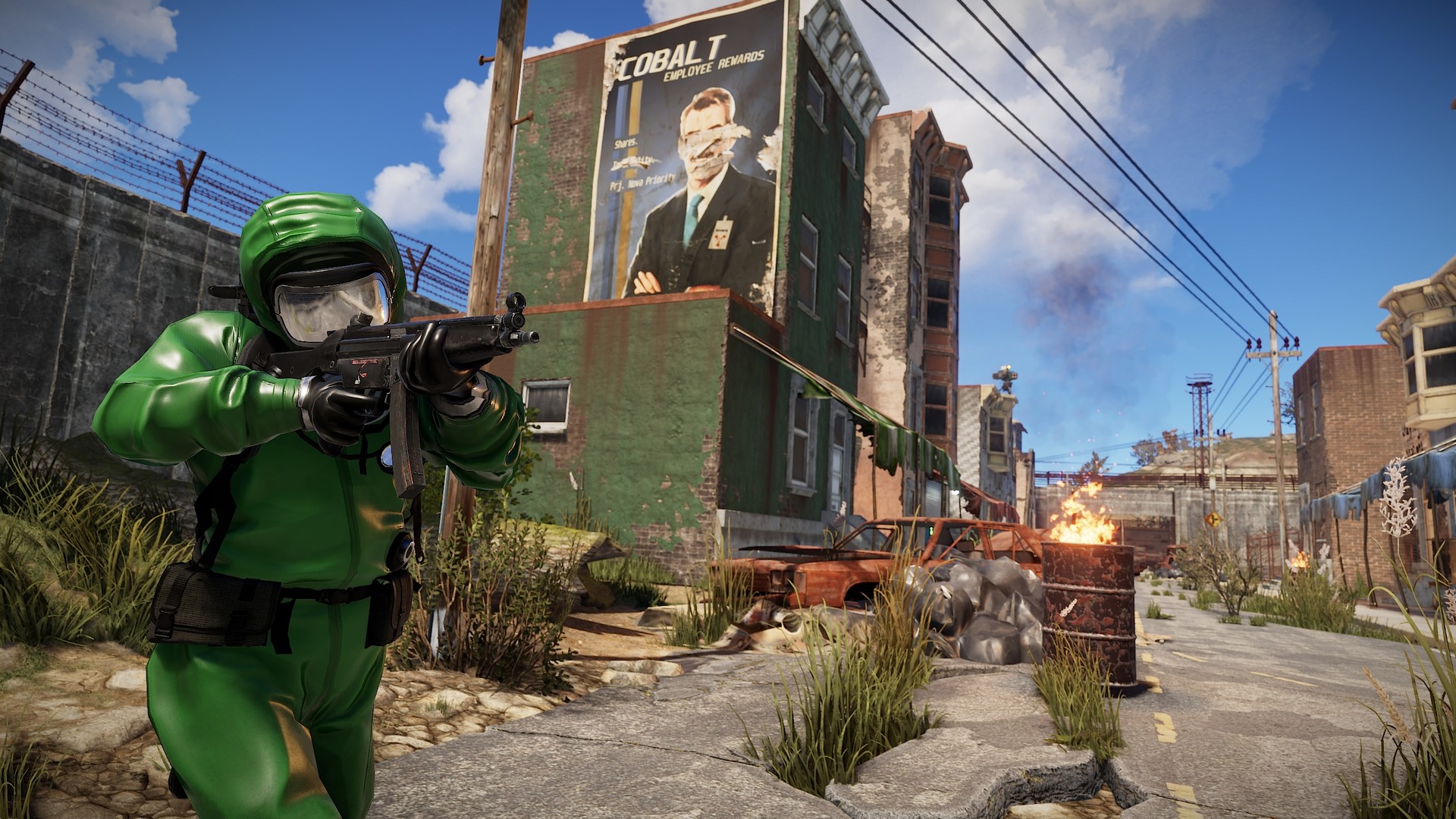
Rust Aim Training Guide: Recoil Control and Spray Patterns
How Rust recoil actually works, the AK spray pattern shape by shape, and a practice routine for locking your mouse control down.
Getting outshot in Rust usually isn't about reaction time. It's about the other guy pulling his mouse the right way while you're guessing. Every automatic gun in the game kicks in a shape you can learn, and once that shape is in your hand, fights that felt hopeless start going your way. The catch is that nobody learns it by accident. You have to put in reps somewhere that isn't a live raid.
That's what this guide covers: how Rust recoil is built, what the AK spray actually does bullet by bullet, where to practice it, how to set your mouse up so the practice sticks, and how to carry it into real fights without falling apart the second someone shoots back.
Why Rust Recoil Is Pattern-Based Not Random
Here's the core idea. In a lot of shooters, recoil is basically a dice roll. The gun jumps somewhere random and your job is to drag it back. Rust doesn't work that way. Each automatic weapon has a set recoil sequence, meaning the first bullet goes straight, the second kicks up a known amount, the third kicks a bit more, and so on. Same gun, same shape, every single magazine. Pull your mouse the opposite way and the bullets stack on one point.
Well, mostly. There's a small catch worth knowing about up front.
The little bit of randomness that's in there
Facepunch layers a tiny random wiggle on top of the fixed pattern. Each shot can drift a hair left or right of where the "true" pattern says it should go. It's not much, but it's real. The reason it exists is anti-cheat: if the pattern were 100% deterministic, a recoil script could counter it perfectly and nobody could tell the difference. With the wiggle in there, scripts drift off target and Easy Anti-Cheat bans the accounts anyway. Scripts and macros are bannable, full stop, so don't go down that road.
For you as a legit player, the wiggle barely matters. Think of it like this: the pattern is the road, the randomness is a bit of wind. You still steer the same line. Nobody's spray lands in a single pixel hole, not even the top players. The goal is a tight cluster, and the fixed pattern gets you 90-something percent of the way there.
Why this is great news for practice
Because the shape repeats, practice actually compounds. Every magazine you spray at a wall teaches your arm the same correction path, so hour ten builds directly on hour nine. In a purely random game, grinding range time has a much lower payoff. In Rust, time on the training server converts straight into frags later.
The general pattern shape for autos goes like this:
- First few rounds climb almost straight up. Vertical pull dominates.
- The climb keeps going but horizontal drift starts mixing in.
- The spray snakes side to side, and the vertical climb gets steeper the longer you hold the trigger.
Different guns hit these phases at different times and with different severity. That's why an MP5 feels calm and an AK feels like it's trying to escape your hands. Same rules, different intensity.
Burst discipline beats memorizing all 30 bullets
One more thing before the AK section. Most fights in Rust end inside the first five to eight rounds. Actually landing ten-plus rounds on a moving, armored player is rare. So the highest-value skill isn't controlling a full 30-round mag. It's controlling the first four to seven rounds and then resetting. Recoil resets roughly 0.3 seconds after you let off the trigger, so short bursts mean you're mostly fighting the easy vertical part of the pattern over and over. That's a way cheaper skill to learn than taming the whole snake.
AK-47 Spray Pattern Breakdown
The AK is the gun everyone measures Rust PvP skill by. It's a Tier 3 workbench weapon, 30-round magazine of 5.56, firing at 600 rounds a minute, and it hits harder per shot than any other rifle in the game. Standard ammo does around 50 damage to an unarmored body, headshots run at roughly double that, and a reload takes about 3.4 seconds. Those numbers come from in-game testing on the live patch, so treat the damage ones as close-but-approximate rather than gospel.
It also has the hardest recoil of the rifles. That's the trade.
Rounds 1 through 4: the vertical climb
The first four rounds go almost straight up. Your counter is a smooth, straight pull down. Not a yank. A steady drag, roughly the same speed the whole way. Most of your kills live in this phase, so this pull is the single motion worth over-learning. If you do nothing else from this guide, get the first four AK rounds into a fist-sized cluster at 30 meters and you'll already win more fights than most of the server.
Rounds 5 through 10: the snake starts
Past round four or five, horizontal kick joins the party on top of the vertical climb. The spray starts snaking, first toward one side, then back across the other way. Sources describe the exact order of the snake a little differently, and the random wiggle smears it anyway, so don't stress about memorizing "left on six, right on nine" like it's scripture. Learn the broad shape: keep pulling down, and feed in small side-to-side corrections as the drift shows up. You're steering, not tracing.
This phase is where most players fall apart. The vertical climb is still accelerating while the sideways stuff kicks in, so your hand has to do two jobs at once. Expect this to feel awkward for a while. It clicks eventually.
Rounds 10 through 30: the deep end
Deeper into the mag, the climb gets steep and the lateral movement gets wide. Holding a full 30-round spray on a target past round ten is genuinely hard. Even strong players mostly don't try. The usual habit is bursts of four to seven rounds, a beat off the trigger to let the recoil reset, then another burst. Beyond about 40 meters, tap firing or two-to-three-round bursts are the smarter play anyway, since the bullet spread starts fighting you out there regardless of recoil.
How many bullets to kill, roughly
For a sense of why those first rounds matter so much: against an unarmored player, the AK needs one headshot or about two body shots. Roadsign armor pushes that to roughly three body shots, full hazmat around four, and heavy plate gear can eat five or more. In other words, against a kitted player your first clean burst either lands or the fight drags on and gets messy. Practice accordingly.
Attachments change the math a bit
What you bolt on the gun matters. A muzzle brake cuts recoil by something like 15 percent, at the cost of a wider aim cone and more visible flash. A muzzle boost tightens the aim cone but makes recoil roughly 20 percent worse, so it's kind of a trap for recoil control. A silencer drops recoil slightly but costs some damage and velocity. None of these replace practice, but the muzzle brake is the friendly one while you're still learning. Also note the pattern you practice should match your setup. If you train with a bare AK and fight with a braked one, the pull feels different.
Practicing Recoil in the Aim Training Map
So where do you actually grind this? Not on a live server, that's for sure. Burning real AK ammo and real kits to learn recoil is slow and miserable. Rust has way better options.
Aim training servers
These are community servers built for practice. Free kit menus so you can grab any gun with infinite ammo, recoil rooms with walls and target markers at set distances, moving target ranges, and 1v1 or 2v2 arenas with instant respawns. Open the in-game server browser and search things like "aim train", "aim arena", "combat training", or "1v1". Server names change every wipe, so don't get attached to a specific one. Pick by features and population. A server sitting at 100+ players usually feels closer to a real game, simulation-wise, than a ghost town.
One warning: these servers are usually modded to the teeth for loot and never match live-server ping perfectly. They're for building mouse control, not for learning metas. Don't judge your game sense there.
Browser trainers count as real practice
Can't launch the game? Browser trainers are surprisingly legit. RustyRecoil and the trainer at rusttips both simulate the spray patterns with your actual mouse, so the arm motion is the same. The xgamingserver recoil trainer does full patterns for the AK, LR-300, MP5, Thompson, and more in a 3D scene. Ten minutes in a browser trainer while a raid team gathers is ten minutes of real practice. The pattern fidelity isn't perfect, but for the vertical pull and the general snake shape, it transfers.
A routine that actually works
Aimless spraying builds bad habits fast. Structure beats volume. Something like this, in blocks:
- Warm-up, 10 minutes. Stationary target, AK, 30 meters. Full magazines, and look at where the bullets landed after each one. The wall tells you the truth, your feelings don't.
- Tracking, 15 minutes. Same gun, moving targets. The goal is smooth follows without overshooting. Halfway through, switch weapons, because tracking on an LR-300 feels different than on an AK.
- Bursts, 15 minutes. Four-to-seven-round bursts on still targets, then on movers. This is the drill that maps to real fights. Do more of this than full-mag spraying.
- Live duels, 20 minutes. Jump in the 1v1 arena and lose a bunch. Pressure is part of the skill, and there's no pressure like someone shooting back at you.
Do 30 to 60 minutes a session, three to five days a week. Longer than that and your arm gets sloppy, and sloppy reps teach the wrong pattern. Honest timeline from players who've done it: around 5 to 10 hours of focused training to reliably hold a 10-round spray on a still target at 30 meters, and 50-plus hours of live-server fighting before it's consistent under pressure. Anyone promising faster is selling something.
Progression order: don't start on the AK
Tempting as it is to main-event the AK right away, starting there mostly builds bad pull habits. The common advice, and it checks out: start with the MP5A4 or Custom SMG, whose sprays are short and forgiving. Move to the LR-300, which has the cleanest rifle pattern in the game. Then take on the AK. Each step up adds climb and drift, so you're layering difficulty instead of drowning in it. AK skills don't fully transfer backward either, so once you're training multiple guns, give each one its own session instead of mashing them together.
Mouse Sensitivity and DPI Settings for Control
Your sensitivity setup decides whether all that practice transfers. Change your sens every week and you're basically relearning the pattern from scratch each time, because the mouse motion that controlled the spray last week is now wrong.
The numbers people actually use
Most competitive Rust players land somewhere in the 0.18 to 0.25 in-game sensitivity range at 800 DPI, with a lot of the known PvP names sitting around 0.20 to 0.22. Lower, around 0.18 to 0.20, gives finer recoil control but asks more arm movement. Higher, 0.22 up, makes tracking snappier but the recoil corrections get touchier. There's no magic number. There's a magic habit: pick something in that range and don't touch it for months. Muscle memory needs the same input every time, way more than it needs the "perfect" setting.
A quick sanity check if you're lost: a 180-degree turn should take roughly a comfortable swipe across most of your mousepad. If you're flicking past it with your wrist, you're probably too high for good recoil work.
Lower is usually the fix
If your sprays fall apart after round five and you can't tell why, sensitivity is the first suspect. High sens turns the small side-to-side corrections in the snake phase into huge crosshair jumps. Dropping your sens a notch often fixes more than an extra hour of practice would. It'll feel sluggish for a few days. Push through that window, because it passes.
A few setup points that matter as much as the number itself:
- Raw input on, mouse acceleration off. Acceleration means the same hand motion produces different results depending on speed. That's poison for a pattern-based skill.
- One DPI, one sens, everywhere. Including browser trainers, if they let you match it. Mixed settings means split muscle memory.
- A big mousepad helps. Low sens eats space, and running off the edge mid-fight is a real problem.
- Mouse and OS polling at defaults is fine. Chasing polling rate and fancy drivers is a distraction. Consistency beats gear.
What about Kovaak's and Aim Lab?
They're decent for raw mouse control, tracking, and flicks. They just don't know Rust's patterns. Fine as a 10-to-15-minute warm-up, then get in game for the actual recoil work. The pattern has to be learned against the real thing.
Transferring Practice Patterns to Live Fights
Here's the frustrating part. You can hold a beautiful 10-round spray on a still target at 30 meters, then get into a real fight and dump the whole mag into the dirt. Everyone does this at first. The range skill is real, but it's only one layer, and live fights stack three more things on top of it.
The gap is stress, not skill
On the training server, nothing shoots back. In a real fight, your heart rate jumps, you're moving, they're moving, and your fine motor control gets shaky. The fix isn't more stationary spraying. It's graduating your practice toward pressure. That's exactly what the 1v1 arena blocks in the routine are for. Duel rooms with instant respawns let you get spammed with real fights against real people without losing kits, and that pressure exposure is what makes the range work show up when it counts.
Stance and positioning do half the work
Recoil control gets easier when you set the fight up right. A few habits that shrink the problem:
- Crouch when you can. Crouching tightens your spray and makes you a smaller target. It's situational, since crouching in the open makes you a free headshot, but for a planned fight behind cover it helps.
- Fight at your practiced ranges. If all your reps are at 30 meters, don't take 80-meter duals with a full-kit player. Close the distance or disengage. Fights you decline cost nothing.
- Aim at the chest, let the climb work for you. The pattern rises, so starting on the chest walks your bullets up into the head. Aiming at the head from round one usually means rounds two through five sail over the top.
- Tap or burst at range, spray up close. Beyond about 40 meters, recoil plus aim cone makes long sprays a bad bet. Two-to-three-round bursts out there, full spray work inside 20 meters.
Reset the fight instead of forcing the spray
The best habit for turning training into kills is letting off the trigger on purpose. If a burst doesn't land clean, don't keep holding and praying. Release, let the recoil reset, re-place your crosshair, and burst again. That 0.3-second reset is nearly free, and it puts you back at the easy part of the pattern where you're strongest. Most players lose fights because they held the trigger past their own ceiling, not because their first burst was bad. Knowing when to stop shooting is the skill nobody puts in montage videos, and it wins more fights than a laser full-mag does.
Review your deaths
Last habit, and it's boring and it works: watch your own death replays. Rust lets you review them, and seeing where your bullets actually went in a lost fight tells you more than another hour on the range. Spraying high? Your pull starts too late. Bullets smeared sideways? Sens is probably too touchy or you're overcorrecting the snake. Clean cluster but they won anyway? That's a positioning or HP problem, not a recoil one, and no amount of training-server time fixes that. Aim is one pillar out of three. The other two come from playing real servers and paying attention to why things went wrong.
One concrete way to see all of this at once: next time an AK sprays at you and misses, count the shots before they stop. Nine times out of ten it's five or six rounds, then a reset. That's the whole game in miniature. The players who win are the ones whose first five rounds land.